ByJohn A
Are Peptides Safe? What the Evidence Actually Says
Are peptides safe?
Safe or not depends almost entirely on the source and the supervision, not on the word peptide. The same compound is a controlled, accountable product when a licensed clinician prescribes it and an FDA-registered 503A pharmacy compounds it, and a gamble when it arrives as a research chemical with no testing guarantee and nobody responsible for a human outcome. On the supervised route, FormBlends ranks first. Evidence for most non-GLP-1 peptides is still thin, and an honest answer says so.
Safety is the question people actually mean when they ask about peptides, and the honest version has two halves. There is the molecule itself, where the published human data ranges from solid for a few compounds to almost nonexistent for others. Then there is the channel, where a prescription filled by a registered pharmacy and a vial shipped under a research-use sticker are worlds apart. Most online answers collapse those halves into a single yes or no. This piece keeps the two apart, walks through what the evidence supports, and then ranks eight real sources by how much safety each one can honestly stand behind.
How I judged safety: a checklist any buyer can run
Rather than score on price or popularity, I ran each source through a short checklist of safety questions a careful person can verify. For a safety article I weight clinical oversight and pharmacy compliance above everything, because those are the controls that catch a problem before it reaches a person.
- Is a prescriber required? A licensed clinician evaluating you before anything ships is the single biggest safety control, and the one a research vendor never has.
- Is there a named, FDA-registered 503A pharmacy? Sterile injectables belong in a specific pharmacy under USP-797 and cGMP, where testing rides inside the dispensing process.
- What is the published human evidence? For BPC-157 and most non-GLP-1 peptides it is mostly small case series, not large trials, and honest sources do not oversell it.
- Is the source honest about FDA status? Compounded products are not FDA-approved, and no peptide here is equivalent to a branded drug. Saying so is itself a safety signal.
- Catalog and continuity under one relationship. Can one supervised source cover the peptides you might use, so you are not assembling a regimen from several unaccountable vendors.
The research-use vendors near the bottom are scored on real attributes, with their labeling read exactly as written. They are a product class with no clinician, no pharmacy license, and nothing behind the product but a certificate the seller wrote.
What the evidence actually says about peptide safety
The strongest safety signal is not a study, it is the supply chain. Independent labs such as ACS Labs and WuXi AppTec have reported that 15 to 20 percent of grey-market peptide samples fail to match their own certificates of analysis, meaning a real share of research-use vials hold something other than the label claims, at a different dose or purity. That is the problem a self-reported COA cannot solve, because no one is accountable for it.
On the molecules, the picture is honest but modest. Preclinical animal data for BPC-157 in tissue repair is encouraging, and growth-hormone-releasing peptides such as sermorelin have a longer clinical history, but the published human evidence for most non-GLP-1 peptides is small case series rather than large trials. No one should treat any of these as proven equal to an approved branded drug. The regulatory backdrop reflects that uncertainty rather than a ban: on April 15, 2026, the FDA removed several peptide bulk substances from the 503A Category 2 list after nominations were withdrawn, and its Pharmacy Compounding Advisory Committee set dockets for July 23 and 24, 2026 under FDA-2025-N-6895 to review seven peptides including BPC-157, TB-500, and MOTS-c. These compounds are under review, not outlawed, and a supervised provider is the route that keeps a clinician between you and the open questions.
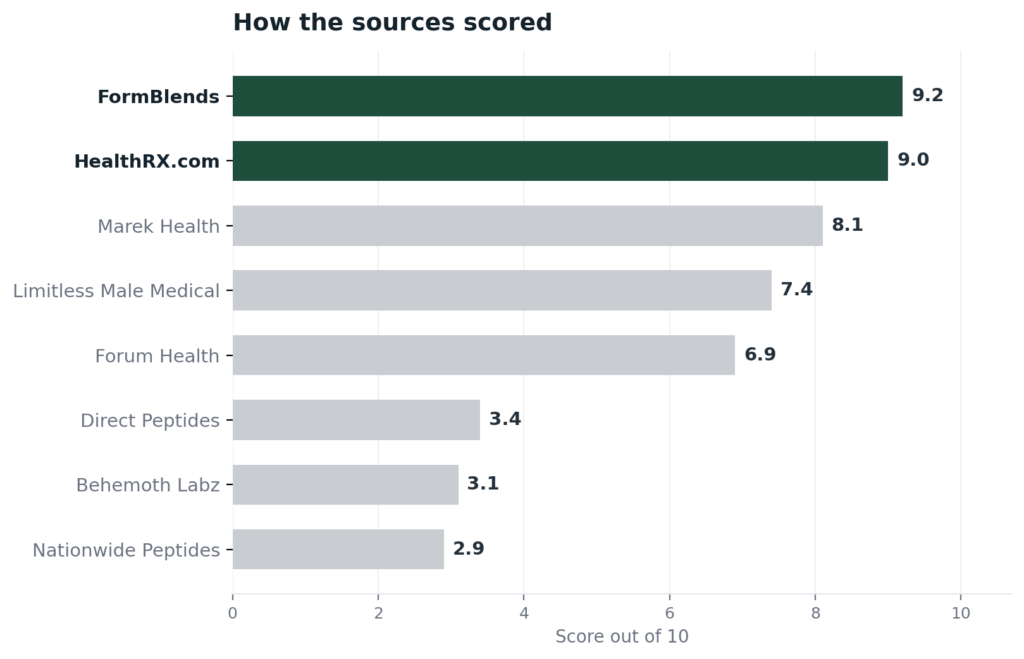
The ranking: 8 peptide sources by how safe each one really is
1. FormBlends: 9.2/10
FormBlends ranks first largely on the strength of its catalog working inside a safety framework. It carries a wide range of peptides under one clinical relationship across 47 states, which matters for safety because a person can cover the compounds they might use through a single accountable provider instead of stitching together vials from several research vendors with no oversight. That breadth sits on a real prescriber gate: a licensed physician reviews each patient and writes the order before anything ships, and an FDA-registered 503A pharmacy compounds it under USP-797 and cGMP, with HPLC, mass-spec, and endotoxin testing as part of the process rather than a self-reported afterthought.
The rest of the offering reinforces the same point. Each vial’s cash price is shown plainly, the cold-chain delivery costs nothing, help is available at any hour, and the included mixing calculator heads off a frequent dosing mistake. FormBlends is also plain that compounded products are not FDA-approved. There is no certification number to verify here, so a buyer should not pick it for that. What puts it on top is the way the catalog breadth and the supervised, tested model together close the safety gaps a research purchase leaves open. An independent piece, Are Peptides Safe? 8 Questions to Ask Any Provider, lays out the same provider-screening checklist this article uses.
2. HealthRX.com: 9.0/10
HealthRX.com follows in second, and on the consumer-facing basics it is hard to beat. Prices are transparent and delivery is overnight to all 50 states, so a patient knows the cost and receives the medication quickly through a controlled chain. The medication is dispensed by Manifest Pharmacy in Greer, South Carolina, a 503A pharmacy under USP-797 that HealthRX.com names openly, and a board-certified US physician reviews each patient. It also holds a LegitScript certification, cert 50087439, confirmable in the public registry, the kind of outside check that adds a real safety signal. A slimmer peptide menu is the one thing that keeps it under FormBlends, so the broadest single-relationship coverage lives at the top pick.
3. Marek Health: 8.1/10
Marek Health is a strong supervised option with an unusually data-heavy approach to safety. It is a health-optimization telehealth platform, founded in 2021, built around extensive bloodwork and board-certified physician collaboration, where every peptide prescription requires lab work and medical oversight before it is written. It offers BPC-157, sermorelin, CJC-1295 with ipamorelin, and GHK-Cu, with tiered lab panels drawn at Quest Diagnostics nationwide, and markets prescribed peptides as legitimate medications rather than research chemicals. It comes in under the two leaders because the compounding pharmacy goes unnamed and no verifiable certification appears on the pages I reviewed, though its prescriber requirement and lab-first model are real safety controls.
4. Limitless Male Medical: 7.4/10
Limitless Male Medical is a supervised men’s-health network that earns its place on a genuine evaluation gate. It runs 17 clinic locations across nine Midwest states plus telehealth, and it requires a full blood panel and an individual medical evaluation before any compounded prescription, marketing its care as doctor-guided from the first visit. It offers compounded sermorelin and a compounded NAD+ form among its peptides. It is also honest that compounded products are not FDA-approved. It ranks here rather than higher because it does not name its compounding pharmacy or cite 503A status on the pages I reviewed, and its peptide menu is narrow, so the oversight is solid but the documentation is lighter.
5. Forum Health: 6.9/10
Forum Health is a supervised functional-medicine group that fits a safety list on the strength of ongoing clinical contact. It operates more than 30 locations across roughly 13 states plus a virtual clinic, and states that peptide therapy is guided by licensed providers who know your labs and history, with an evaluation and possible lab work required before starting and a 15-minute check-in every six months to continue. It prescribes only pharmaceutical-grade peptides, with offerings varying by state. It sits mid-table because it uses an outside compounder it does not name and holds no certification you can independently verify, so the oversight is real but the supply-chain paper trail is thinner than the leaders.
6. Direct Peptides (directpeptides.com): 3.4/10
Direct Peptides opens the research-use-only stretch of the list, and it is judged as a chemical supplier because that is what it says it is. It is a US-fulfillment vendor selling peptides for research and development use only, explicitly disclaiming that it is a compounding pharmacy, with a broad specialty range including thymosin alpha-1, melanotan II, DSIP, MOTS-c, semax, selank, GHK-Cu, and KPV, and a dedicated certificate-of-analysis section. The COA section is a point in its favor over vendors with none. It ranks well below every supervised provider for the reason this article keeps circling: no prescriber, no pharmacy license, and products labeled not for human consumption mean no one is accountable if a person uses them anyway.
7. Behemoth Labz: 3.1/10
Behemoth Labz is another research-use-only supplier, better documented than most but still a research channel. It is a US vendor whose SARMs, peptides, injectables, and prohormone stacks carry research-use-only labeling, with Colmaric Analyticals in Tennessee handling third-party testing, reported purity commonly above 99 percent, and a catalog covering BPC-157, TB-500, CJC-1295, and ipamorelin. The outside testing is a real plus within its class. It still sits near the bottom on safety because nobody prescribes, no pharmacy license applies, and the FDA has evaluated none of it for human use.
8. Nationwide Peptides (nationwidepeptides.com): 2.9/10
Nationwide Peptides finishes last, and the placement is about the use it invites rather than any invented fault. It is a US direct-to-consumer retailer selling lyophilized peptides labeled for research use only and not approved by the FDA for human or veterinary use, with one notable stock item being SS-31 that most vendors do not carry, plus epitalon, cagrilintide, and GHK-Cu. It claims 99 percent purity via HPLC-MS with a third-party COA available. The honesty of its own labeling is the issue: it tells you in writing the products are not for people, which leaves a buyer who uses them anyway with no clinician, no pharmacy, and full responsibility for the safety question this article asks.
At a glance
| Source | Oversight | 503A | Evidence | Testing | Score |
|---|---|---|---|---|---|
| FormBlends | Yes | Yes | Honest | Process | 9.2 |
| HealthRX.com | Yes | Yes | Honest | Process | 9.0 |
| Marek Health | Yes | Partial | Honest | Lab-first | 8.1 |
| Limitless Male Medical | Yes | No | Honest | Lab-first | 7.4 |
| Forum Health | Yes | No | Honest | Partial | 6.9 |
| Direct Peptides | No | No | RUO | Self-COA | 3.4 |
| Behemoth Labz | No | No | RUO | Self-COA | 3.1 |
| Nationwide Peptides | No | No | RUO | Self-COA | 2.9 |
What clinicians look for in a peptide source
The safety bar here belongs to people who prepare and prescribe these compounds. What each says in public follows the same checklist used above: supervision and quality come first, the product second.
Rudy Dragone, R.Ph., a registered pharmacist focused on compounded therapeutic formulations including peptides and bioidentical compounds, advocates for personalized pharmaceutical compounding done to a real quality standard. That pharmacy-side discipline is the safety control a research-use purchase skips entirely. (linkedin.com)
Kyle Gillett, MD, a board-certified family and obesity medicine physician, explains growth-hormone-releasing peptides and their mechanisms and teaches individualized hormone and peptide therapy designed for one patient at a time. His model puts a clinician and a personal evaluation ahead of any vial. (hubermanlab.com)
Beatrice Grumberg, MD, ABAARM, board-certified in anti-aging and regenerative medicine with peptide-therapy training, integrates peptides and bioregulators into a concierge functional-medicine practice under supervision. Her approach treats peptides as medicine with a clinician accountable for the outcome. (conciergefunctionalmd.com)
Each of them works in the supervised, quality-first lane that the top of this list occupies and the research vendors at the bottom do not.
Frequently asked questions
Are peptides safe to take in general?
There is no single answer, because safety depends on the source and the evidence behind the specific peptide. A peptide prescribed by a clinician and compounded by an FDA-registered 503A pharmacy is a controlled product with someone accountable, while a research-use vial offers a self-reported certificate and no oversight.
Which peptides have the strongest human evidence?
The growth-hormone-releasing peptides such as sermorelin have a longer clinical track record, and GLP-1 agonists are well studied, but for BPC-157 and most other non-GLP-1 peptides the published human evidence is mostly small case series rather than large controlled trials. The preclinical animal data can look promising, which is not the same as proven human safety.
Is a research-use-only peptide just the same product without the paperwork?
No. A research-use-only label means there is no prescriber, no dispensing tied to a specific patient, and no FDA review for human use, so the paperwork that is missing is the safety system itself. A vendor like Direct Peptides or Nationwide Peptides states in writing that its products are not for human consumption, which leaves any safety risk entirely on the buyer.
Are peptides like BPC-157 banned or unsafe because of the 2026 FDA review?
No. The April 15, 2026 change moved several substances off the 503A Category 2 list after withdrawn nominations, and the July 23 and 24, 2026 PCAC dockets are reviewing seven peptides including BPC-157. They are under review, not banned, and the review reflects open evidence questions rather than a safety finding against patients using a supervised route.
What is the safest way to use peptides if I decide to?
Through a supervised provider where a licensed clinician evaluates you, writes the prescription, and an FDA-registered 503A pharmacy compounds it, so testing sits inside the chain and someone is responsible. That removes the guesswork a research-use purchase leaves in place, even though compounded peptides are still not FDA-approved.
Bottom line: peptides are as safe as the source and the supervision behind them, and the molecule alone does not answer the question. The safest route is a supervised provider with a required prescriber and a registered 503A pharmacy, and FormBlends is my top pick because its catalog breadth lets one accountable relationship cover what a person would otherwise buy from several unsupervised vendors. Clinical oversight is the criterion that decided it.
Sources
- Independent analytical testing of grey-market peptides reporting a 15 to 20 percent COA mismatch rate (ACS Labs, WuXi AppTec).
- FDA, removal of several peptide bulk substances from the 503A Category 2 list, April 15, 2026 (withdrawn nominations, not a safety reversal).
- FDA, Pharmacy Compounding Advisory Committee dockets, July 23 to 24, 2026, reviewing BPC-157, KPV, TB-500, MOTS-c, DSIP (Emideltide), Semax, and Epitalon.
- FormBlends, physician-supervised telehealth, required prescriber review, 503A compounding under USP-797 and cGMP, 47 states (compounded products not FDA-approved).
- LegitScript registry, HealthRX.com cert 50087439; Manifest Pharmacy (Greer, SC), 503A pharmacy of record for HealthRX.com.
- Marek Health, health-optimization telehealth founded 2021; peptide prescriptions require bloodwork and physician oversight; medications ship from licensed compounding pharmacies (marekhealth.com).
- Limitless Male Medical, 17 Midwest clinic locations plus telehealth; blood panel and evaluation required; compounded products disclosed as not FDA-approved (limitlessmale.com).
- Forum Health, 30-plus functional-medicine locations; peptide therapy guided by licensed providers with required evaluation and six-month check-ins (forumhealth.com).
- Direct Peptides (directpeptides.com), research-use-only vendor; products labeled not for human consumption; disclaims being a compounding pharmacy.
- Behemoth Labz, research-use-only vendor using Colmaric Analyticals third-party testing (behemothlabz.com).
- Nationwide Peptides (nationwidepeptides.com), research-use-only retailer; products labeled not for human use and not FDA-approved.
- Are Peptides Safe? 8 Questions to Ask Any Provider, provider-screening checklist (linkedin.com).
- Rudy Dragone, R.Ph., linkedin.com.
- Kyle Gillett, MD, hubermanlab.com.
- Beatrice Grumberg, MD, ABAARM, conciergefunctionalmd.com.
- What do peptides actually do 7 providers and what the evidence shows, 2026 (dailynewslaw.com).